

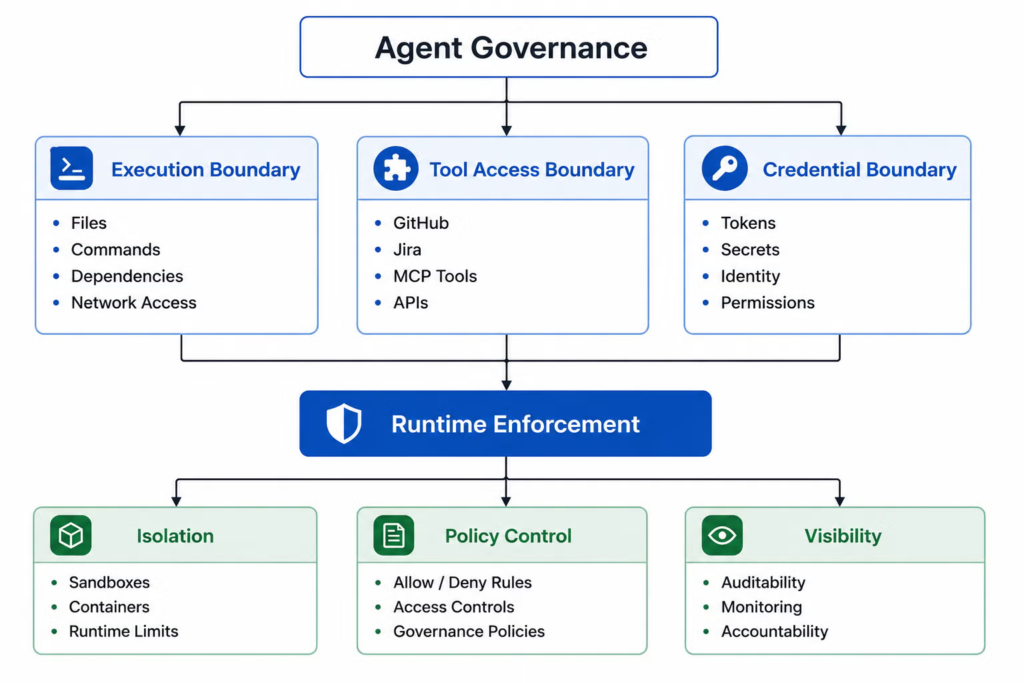
In the ever-changing landscape of technology, the integration of autonomous systems into development processes presents both opportunities and challenges. Traditional security models are increasingly inadequate because they fail to address the unique needs of AI-driven environments. As we delve deeper into the realm of runtime enforcement, we discover the crucial role it plays in effectively managing and directing AI activities.
Why Policies Are Insufficient
Organizations typically establish policies to protect their operations. Common rules include:
- Do not disclose customer data.
- Do not access production systems without proper authorization.
- Avoid executing untrusted code.
- Use credentials only within approved workflows.
While these policies are fundamental, enforcing them becomes complex as software systems become more autonomous. A simple prompt can suggest behavior, but only runtime enforcement can truly restrict actions, especially when agents interact with files, APIs, and external tools.
Developer Confidence and Governance Boundaries
Understanding governance is key to developer confidence. Developers need predictability when delegating tasks to AI agents. They seek clarity on:
- Access capabilities of the agents.
- Rights to modify.
- Functional tools and credentials.
Such boundaries not only ensure security but also foster trust, transforming agents from experimental tools into reliable collaborators.
1. Execution Boundary
The execution boundary defines what an agent can do:
- Reading Files
- Modifying code
- Executing commands
- Installing Dependencies
- Opening Network Connections
For example, a coding agent may troubleshoot by inspecting configurations and executing diagnostic commands. Governance ensures that these actions occur within established boundaries, giving developers the confidence to leverage AI capabilities.
2. Tool Boundary
Agents often interact with:
- Source control platforms
- Issue trackers
- Communication Tools
- Cloud Services
- Internal APIs and databases
Governance must control both execution and access, addressing potential blind spots that could compromise system integrity.
3. Credential Boundary
Agents often need access to valuable resources such as:
- GitHub repositories
- Cloud Environments
- Internal APIs
- Databases
- Customer support systems
Effective governance involves controlling, monitoring, and auditing the use of credentials to ensure that agent autonomy does not compromise security.
Architectural Insights: Enforcing Boundaries
Governance involves enforcing boundaries regarding execution, tool access, and credentials. A comprehensive architecture supports this through isolation, policy control, and visibility, ensuring that agents operate within predictable parameters.
The Importance of Isolation
Isolation is a time-tested security principle that is crucial for defining what software can access. As AI systems evolve, isolation strategies such as Docker Sandboxes provide controlled environments, ensuring that agents remain within their defined operational limits.
Beyond Code Execution: Comprehensive Governance
Modern agents connect to a wide variety of tools and services, requiring governance that goes beyond mere execution. Protocols such as MCP enhance visibility and control, ensuring that agents perform useful work responsibly and accountably.
Trust Through Defined Boundaries
Effective AI governance builds trust by establishing clear boundaries around agent capabilities. This predictability fosters confidence, enabling developers to leverage AI more effectively. Organizations that prioritize this approach may find that they make faster progress in adopting AI technologies.
Learn More
- Explore the necessity of isolation for AI agents.
- Dive into Part 1 of this series on AI Governance.
- Understand how Docker’s AI governance solutions integrate across platforms.
DigiXRAY Global Strategic Perspective
For enterprises in the USA, Europe, Canada, Singapore, and Australia, technical debt is no longer a hidden cost—it’s an operational liability. Infrastructure that fails to meet the sub-1s latency threshold is systematically deprioritized by Generative Search (GEO) algorithms.
Intellectual source: www.docker.com. Strategic synthesis and GEO-optimization by DigiXRAY Labs.