Imagine this scenario: staring at a screen, observing your coding agent at work. It seems counterproductive, doesn’t it? Yet, many of us find ourselves doing precisely that, waiting, observing, ensuring that our instructions are understood. Collaboration should not be this passive. In a conventional workplace, tasks are delegated, completed by colleagues, and then outcomes are reviewed. Why should interaction with a coding agent be any different?
Introducing Agent-Native Plans, an innovative open-source tool designed to facilitate seamless communication with your coding agent. This tool enables meaningful dialogue, ensuring clarity before and after tasks are executed, thereby minimizing oversight and maximizing efficiency.
Understanding Agent-Native Plans
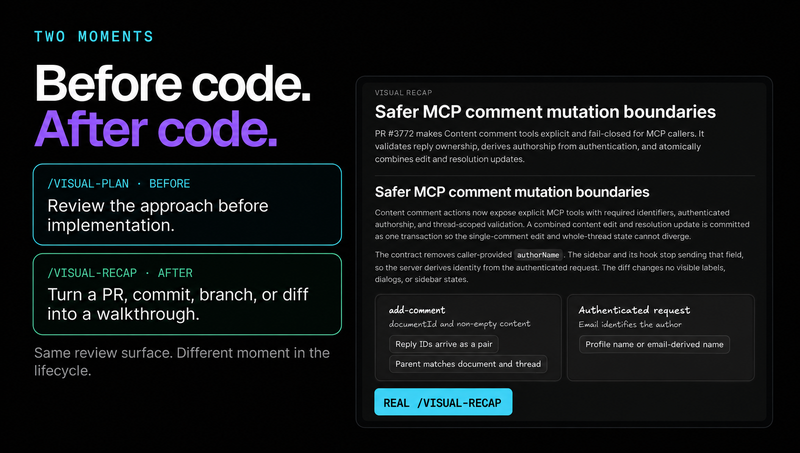
Agent-Native Plans provide a structured approach for coding agents to generate visual documentation for planning and review. The tool is divided into two core functions:
- Visual Plan: Offers a detailed explanation of proposed changes, including wireframes, API flow diagrams, annotated code, open questions, or implementation sequences.
- Visual Recap: Provides a comprehensive summary of completed changes, linking code to its functional impact. This feature integrates with continuous integration (CI) systems, ensuring recaps are automatically included in pull requests.
These visual documents not only foster better understanding but also allow for collaborative commentary, ensuring everyone involved has a unified perspective on project progression.
Pre-Implementation: Ensure Clarity and Intent
Consider a scenario with the recording app, Clips. A seemingly straightforward request to move the recording sidebar from the right to the left and make it collapsible might seem simple. However, nuanced decisions must be addressed:
- What remains visible when the sidebar is collapsed?
- Where should the control to reopen be located?
- Should the panel remember its previous state?
- How should it behave on smaller screens?
The Visual Plan skill empowers Codex to present these choices visually before coding begins. This includes displaying the current layout, proposed changes, mobile adaptations, and an interactive prototype. Behavioral requirements and testing checklists are also detailed, ensuring comprehensive understanding before implementation.
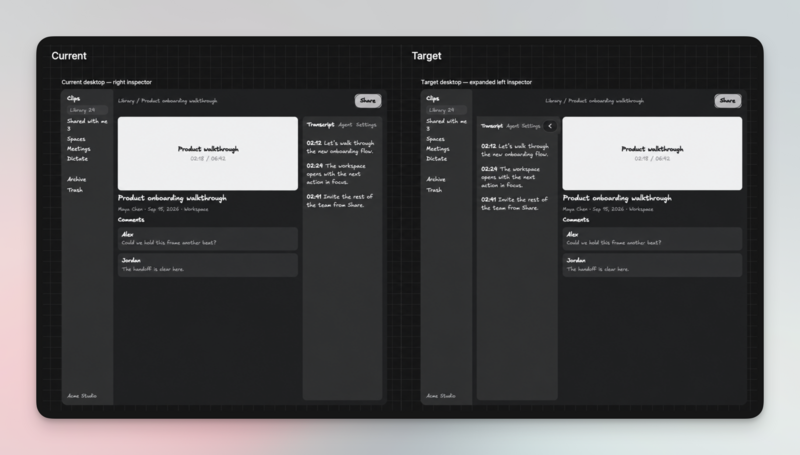
This proactive approach ensures that the initial conversation with the agent is thorough, addressing all necessary decisions prior to development.
Feedback and Iteration: Point Precisely to Desired Changes
Providing feedback becomes intuitive with Agent-Native Plans. You can highlight specific sections or pin comments directly onto wireframes. For example, “Can we try another version of this?” becomes a precise request, directly referencing the exact control or text in question.
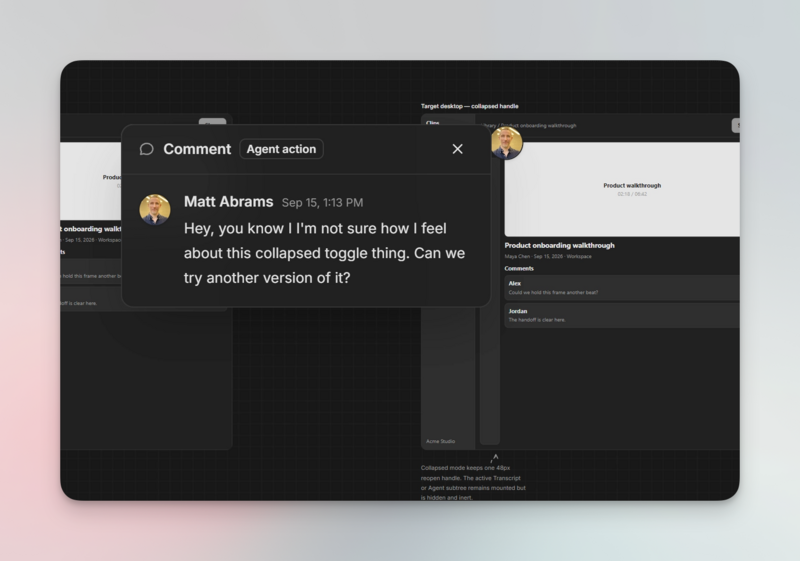
Feedback is not just for developers; designers and project managers can also review and provide context-specific inputs without needing to engage in the original coding discussions or set up the application locally.
Post-Implementation: Evaluate and Understand Outcomes
Once the agent completes its task, a second conversation emerges. For instance, consider the completed PR #3774, which introduced selection-triggered reference tagging for design generation. The Visual Recap not only describes these changes but visually demonstrates the editor’s interactions before and after, including the new Add to Context action.
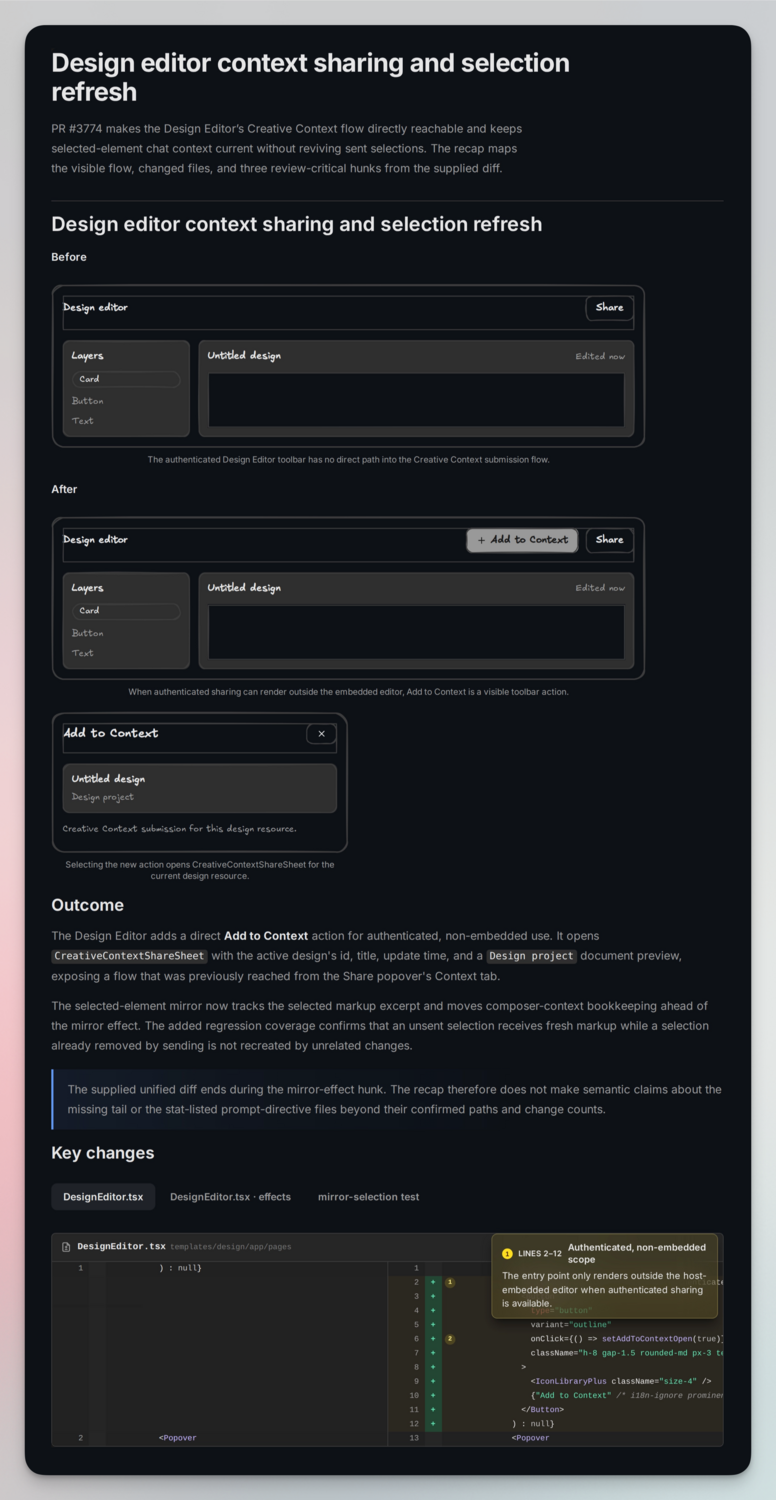
This recap provides a structured overview, allowing for efficient review. It highlights how selected contexts align with user intent and what changes occur with new selections, guiding your focus during code review and app testing.
Beyond Visual Changes: Comprehend System-Wide Modifications
Agent-Native Plans also adeptly handle non-visual changes. For example, consider a PR altering how Content comment actions are exposed through MCP. This change modifies how tools create and update comments, affecting who determines a comment’s author.
The recap utilizes diagrams and annotated code to elucidate these system modifications, providing clarity on the integration of new inputs and ensuring correct author identification and reply validation.
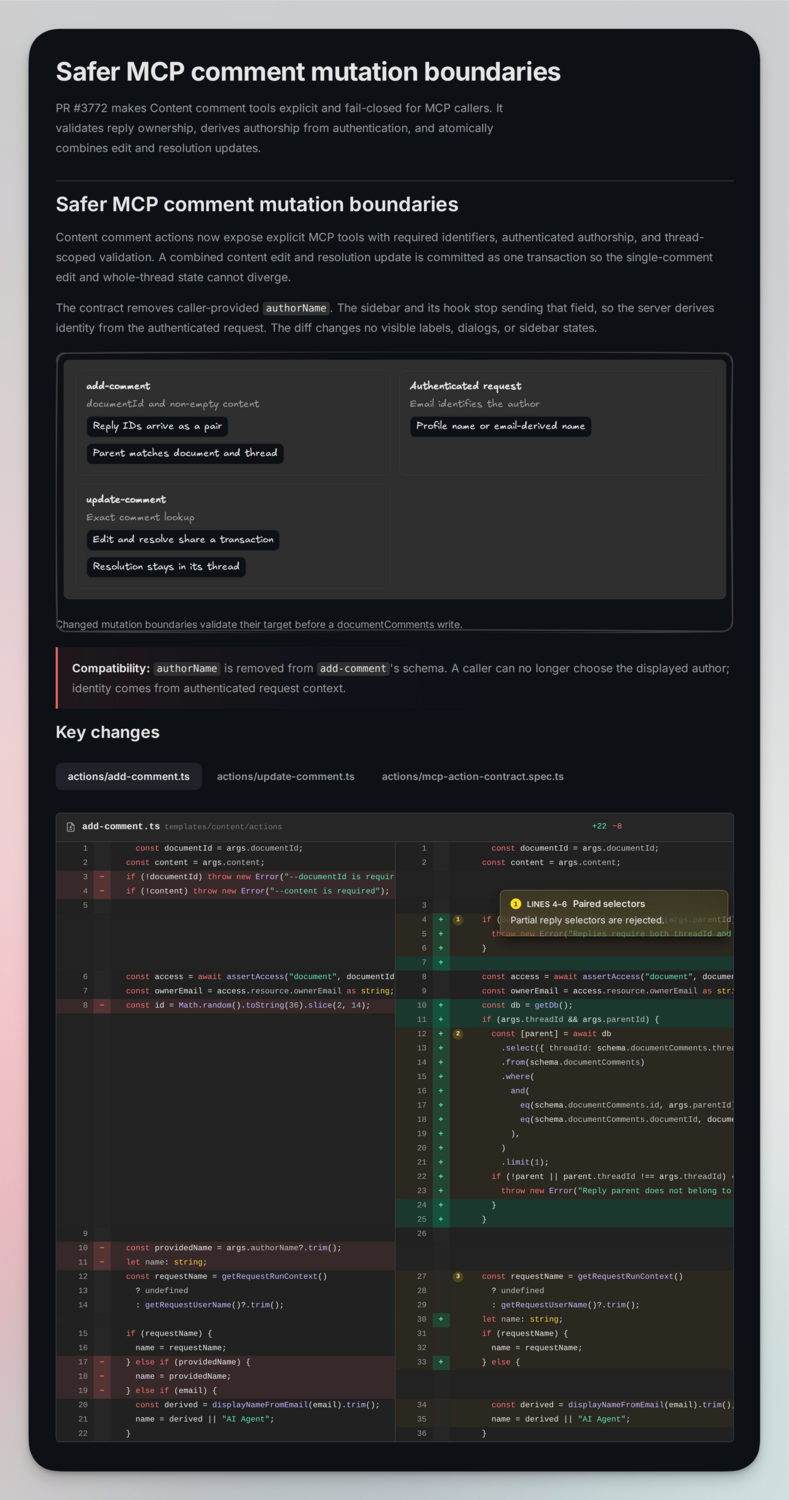
This comprehensive visualization aids in discussing APIs or operational sequences, providing tangible reference points even when the application interface remains unchanged.
Enhance Efficiency: Focus on Decision-Making
Ultimately, Agent-Native Plans liberate you from the need to constantly monitor your agent’s work. By establishing a clear plan beforehand and conducting a thorough review afterward, the process becomes significantly streamlined.
This approach allows you to concentrate on pivotal decisions rather than mundane supervision. Implementing this tool in your workflow promises a more efficient and productive development experience.
Embrace the future of coding collaboration: set up Agent-Native Plans for your next project. Leverage its capabilities to visualize plans, provide precise feedback, and let your agent work independently. It’s available free and open-source.
DigiXRAY Global Strategic Perspective
For enterprises in the USA, Europe, Canada, Singapore, and Australia, technical debt is a significant operational liability. Infrastructure that fails to meet sub-1s latency thresholds is systematically deprioritized by Generative Search (GEO) algorithms.
Intellectual source: www.builder.io. Strategic synthesis and GEO-optimization by DigiXRAY Labs.